UK import duties from China explained — duty rates, import VAT, anti-dumping measures, landed cost calculations, and how to minimise your customs bill in 2026.
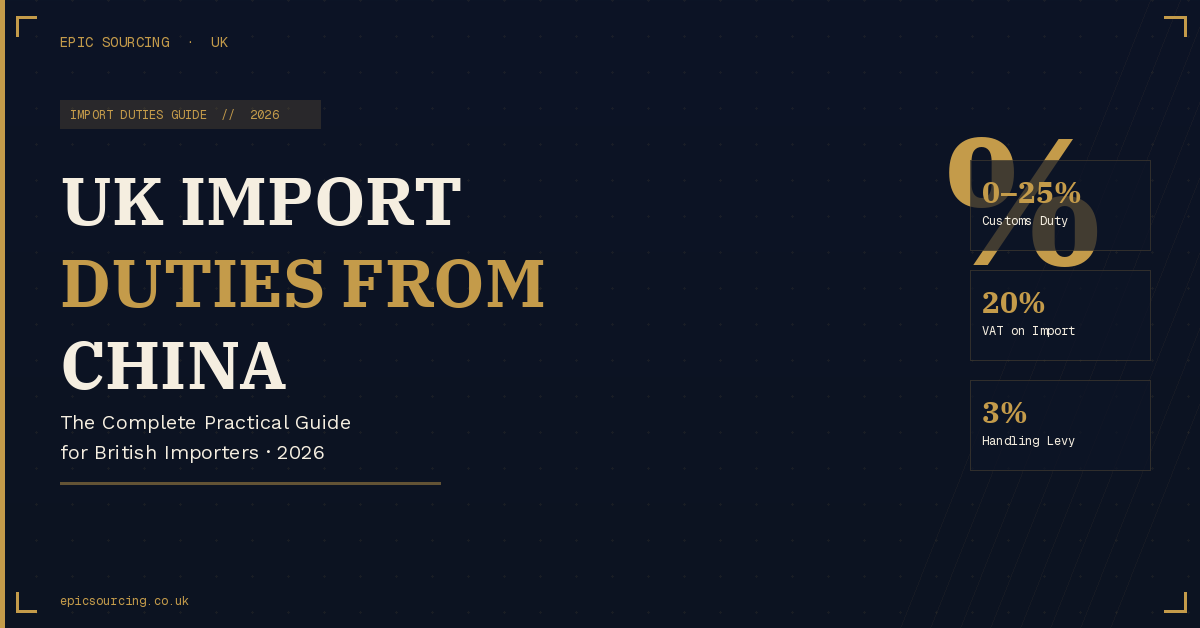
In summary: UK import duties from China in 2026 are charged under the UK Global Tariff (UKGT) at standard Most Favoured Nation (MFN) rates — typically 0–12% depending on your product category — with 20% import VAT applied on top. There is no UK-China free trade agreement. Your total landed cost includes customs duty + import VAT + freight + any anti-dumping duties. This guide walks through exactly what you'll pay, how to calculate your full landed cost, and how to reduce your import tax exposure legally.
Let me tell you about the call I dread most as a sourcing agent. It comes — reliably, heartbreakingly — about three weeks after a client's first shipment clears customs. "TK," they say, voice slightly strained, "the bill from the freight forwarder is... considerably more than we expected."
Nine times out of ten, UK import duties weren't factored into the original business case. Someone saw a factory price of £6 per unit, ran the maths on a thousand-unit order, and thought: brilliant margin. Then HMRC had a word.
I've been helping British businesses import products from China and Vietnam for years. "Surprise duty bills" is the most common — and most avoidable — problem I see. So let's fix that, once and for all. Welcome to our Sourcing 101 deep-dive on UK import duties from China in 2026.
When goods manufactured in China arrive in the UK, HMRC charges a customs duty based on the product's commodity code under the UK Global Tariff (UKGT). The UKGT replaced the EU's Common External Tariff after Brexit, and it determines the duty rate for every category of imported goods.
There is no UK-China Free Trade Agreement — unlike the UK-Vietnam Free Trade Agreement (UKVFTA), which significantly reduces duty rates on Vietnamese-origin goods. Everything from China is assessed at standard MFN rates.
Import duties are calculated as a percentage of the customs value, which is typically the transaction value of the goods (what you paid the factory) plus freight and insurance costs to the UK border.
Sourcing Hack #1:
Many importers forget that the customs value includes freight costs, not just the factory price. If you're shipping a £5,000 order by air express at £800 in freight, your customs value is £5,800 — duty is calculated on that higher figure. Sea freight is significantly cheaper and reduces your dutiable value accordingly.
Duty rates vary considerably by product category. Here's a practical guide for the most common import categories:
0% duty: Many raw materials, certain electronics components, some machinery and capital equipment.
3–6.5% duty: Most consumer electronics, household goods, furniture, sporting goods, plastic products.
6.5–12% duty: Clothing, footwear, textiles, bags, accessories, leather goods.
Higher rates with anti-dumping: Certain steel products, ceramics, specific glass, bicycles.
To find the exact duty rate for your product, identify your commodity code (also called a tariff code or HS code) on the UK Trade Tariff tool. Getting the right commodity code is crucial — declare the wrong one and you're either overpaying or risking HMRC compliance issues. If you're sourcing activewear or fitness products specifically, also see our guide on sourcing activewear from China for UK brands.
Sourcing Hack #2:
When in doubt about your commodity code, ask your freight forwarder or customs broker. Alternatively, apply to HMRC for an Advance Tariff Ruling (ATR). It takes 3–4 months but gives you legally binding certainty before a large import programme. Worth it for ongoing sourcing.
On top of customs duty, you'll pay 20% import VAT on the customs value plus the duty amount. The formula is:
Import VAT = (Customs Value + Customs Duty) × 20%
The good news: if your business is VAT-registered, import VAT is fully reclaimable on your VAT return via Postponed VAT Accounting (PVA) — you don't pay it upfront and wait for a refund. If you're not VAT-registered, import VAT is an unrecoverable cost. Make sure your business is VAT-registered before importing at any meaningful volume.
A practical example: a £10,000 shipment with 6% duty generates £600 in customs duty + £2,120 in import VAT = £2,720 payable to HMRC. If you can't reclaim the VAT, that's a serious margin hit that needs to be in your business case from day one.
Yes — and this is the hidden wildcard that catches importers off-guard. Anti-dumping duties (ADD) are additional tariffs imposed on specific Chinese products where HMRC has determined Chinese manufacturers are pricing below market value, undercutting UK industry.
Categories historically subject to UK anti-dumping duties from China include certain steel and aluminium products, ceramic tiles, specific glass types, bicycles, and some footwear. These can add 15–80%+ on top of your standard UKGT rate.
Always check the UK Trade Tariff for active anti-dumping or countervailing measures before committing to an order. It takes five minutes and can save thousands.
Sourcing Hack #3:
Anti-dumping duties are product and origin specific. If your product is subject to high ADD from China, explore whether it can be sourced from Vietnam, India, or another FTA country instead. This is supply chain diversification — a core part of the strategy we develop for clients through our Private Label and Secret Label packages.
Your landed cost is the total cost of getting a product from a Chinese factory to your UK warehouse, ready for sale. It determines your actual margin — not the factory price.
Landed Cost = Factory Price + Freight + Insurance + Customs Duty + Import VAT + Customs Clearance + Last-Mile Delivery
A practical example: You order 500 travel mugs at £8 each (£4,000 factory cost). Sea freight to Felixstowe: £600. Customs value: £4,600. Duty at 6.5%: £299. Import VAT at 20%: £979.80. Customs clearance: £150. Delivery to warehouse: £80. Total landed cost: £6,108.80 — that's £12.22 per unit, not £8. If you were pricing those mugs at £18 each, your margin is £5.78 — not the £10 you planned for. Always model landed cost before placing any order. If you'd like help, our team can provide a free estimate — get in touch here.
This is a question I've been getting a lot this year. The UK-China relationship has thawed considerably in 2026, with the Starmer government engaging more constructively with Beijing on trade. But here's the honest answer: no formal tariff reductions have been announced as part of any diplomatic dialogue so far.
UK import duties from China remain at standard UKGT MFN rates. There is no active UK-China Free Trade Agreement negotiation that has reached tariff commitments. Plan your import costs on current UKGT rates — we'll update clients as this develops.
What the improved relationship does mean: smoother trade dialogue, potentially faster resolution of specific disputes, and better access for UK businesses engaging Chinese government-connected suppliers. Watch this space.
Sourcing Hack #4:
Even without a UK-China FTA, you can reduce your effective duty rate by sourcing from countries that do have FTAs with the UK. Vietnam is the standout option — the UKVFTA means many Vietnamese-origin goods attract 0% duty. Our sourcing specialists can advise whether your product is available from Vietnam at comparable quality and cost.
Before you can import goods from China, your business needs an EORI number (Economic Operators Registration and Identification) — your unique identifier in UK customs systems. Apply via HMRC for free; it typically takes about a week.
You'll also need to file an import declaration (or have your customs broker file one on your behalf) through the Customs Declaration Service (CDS) for every shipment. Most freight forwarders include customs brokerage in their service — basic customs clearance runs £60–£150 per shipment.
A good China sourcing agent doesn't just find factories — they help you structure your supply chain to minimise total landed cost. That includes finding factories in lower-duty countries (Vietnam, India, Bangladesh), optimising packaging to reduce freight costs, structuring shipments to minimise clearance overheads, and checking commodity codes before production to eliminate border surprises.
At Epic Sourcing, we've helped UK clients achieve 20–40% landed cost savings through smarter sourcing strategy. Take a look at our White Label and Private Label packages to see how we work.
Import duty rates vary by product under the UK Global Tariff (UKGT). Most consumer goods attract 3–12%, while many electronics and raw materials are 0–3%. You'll also pay 20% import VAT on the customs value plus duty. Use the UK Trade Tariff tool to find your specific commodity code and rate.
The UK's de minimis threshold for customs duty is £135 — goods valued at £135 or less are not subject to import duty, though import VAT still applies. This threshold is under review and may change before 2029. For business-to-business imports, assume duty applies from the first penny of value.
Commercial samples may qualify for duty relief if they're clearly unsaleable as presented, marked as samples, and imported in limited quantities. Most sample shipments come via courier (DHL, FedEx) at low declared value and are cleared informally — but always declare honestly to avoid HMRC compliance risk.
Use the free UK Trade Tariff tool at trade-tariff.service.gov.uk. Search by product description and drill down to the 10-digit commodity code. If uncertain, a customs broker can classify your goods professionally, or apply to HMRC for an Advance Tariff Ruling (ATR) for legal certainty.
Yes — this is one of the most effective duty reduction strategies for UK importers. Under the UK-Vietnam Free Trade Agreement, many Vietnamese-origin goods attract 0% or significantly reduced duty rates. Our team can advise whether your product is available from Vietnam at comparable quality. See our complete importing guide for more detail.
Customs duty is a percentage of your goods' customs value determined by commodity code — generally not reclaimable. Import VAT is 20% applied on top of customs value plus duty — VAT-registered businesses can reclaim it via Postponed VAT Accounting. Both apply to most commercial imports from China.
Understanding UK import duties is step one. Structuring your supply chain to minimise them — legally and efficiently — is where the real savings happen. Whether you're placing your first order from China or looking to reduce costs on an established supply chain, our team at Epic Sourcing is here to help.
Book a free strategy call or email us at hello@epicsourcing.co.uk — 07551 136406.
Also worth reading: Importing from Alibaba to the UK | How Small Businesses Can Cut Costs by Sourcing Directly | How to Find Reliable Manufacturers in China
Written by TK Wang, Founder & Director @ Epic Sourcing | hello@epicsourcing.co.uk | 07551 136406