The July 2026 UK-China JETCO meeting made headlines — but did anything actually change for businesses importing from China? Here's the honest breakdown every UK importer needs to read.
In summary: The July 2026 UK-China JETCO (Joint Economic and Trade Commission) meeting delivered positive diplomatic progress and £2.2 billion in trade wins — but for businesses importing goods from China into the UK, nothing changed. Standard UK Global Tariff rates still apply. There is no UK-China FTA. Here is what UK importers need to know right now.
On 2 July 2026, UK Trade Secretary Peter Kyle sat down at Mansion House in London with China's Minister of Commerce Wang Wentao for what both sides called a landmark trade meeting. Together, they co-chaired the latest session of the UK-China Joint Economic and Trade Commission — known as JETCO — the principal bilateral forum for both governments to discuss trade, market access, and economic cooperation.
The headlines were genuinely encouraging. £2.2 billion in export deals announced. A commitment to a Professional and Business Services Matchmaking platform. A feasibility study for a bilateral Trade Services Agreement. And China agreeing to cut tariffs on UK whisky exports from 10% to 5% — worth an estimated £250 million to British distillers over five years. Twas' a very good day for Scotch whisky.
But from my inbox, a very different question kept arriving: "TK — does this mean import duties from China are going down?" It's a fair question. So let me give you a straight answer.
No. If you are importing goods from China into the UK — clothing, electronics, homewares, gym equipment, packaging, or anything else — your duty position has not changed. Standard UK Global Tariff rates still apply across all product categories. The July 2026 JETCO meeting produced no changes to goods import duties whatsoever.
The meeting focused heavily on UK services exports to China — financial services, professional services, education, and technology. Valuable for certain British sectors, but not a duty announcement for UK importers of physical goods.
The one specific tariff change — China reducing duties on UK whisky — flows in the opposite direction. It benefits UK exporters to China, not businesses sourcing goods from China to sell here. An important distinction worth keeping front of mind.
Sourcing Hack #1:
Do not wait for a UK-China trade deal to reduce your landed cost — it could be years away. The levers available to you right now: negotiate better FOB pricing directly with factories; consolidate shipments to reduce freight per unit; apply for a duty deferment account with HMRC to manage cash flow on large orders; and review whether any of your products qualify for preferential duty rates from alternative sourcing countries like Vietnam. These wins are yours today — no trade negotiation required.
Even without tariff changes, the JETCO outcomes are not irrelevant to businesses with China supply chains. The key read-through for importers: the diplomatic environment improved, and that has real value even when it doesn't show up immediately on a landed cost spreadsheet.
Better UK-China relations means reduced risk of sudden punitive tariffs, retaliatory trade measures, or the kind of geopolitical friction that disrupted supply chains between 2018 and 2022. For UK businesses dependent on Chinese manufacturing, political stability is genuinely valuable — even when invisible.
Equally significant: the meeting produced no new anti-dumping investigations, no new import restrictions, and no new sourcing red flags. For UK businesses with established Chinese supply chains, this is effectively a green light to keep building those supplier relationships with confidence.
Sourcing Hack #2:
Anti-dumping duties are the hidden cost that catches UK importers off-guard. Standard UKGT rates are predictable — but if your product category carries active anti-dumping measures (currently common for certain tyres, e-bikes, solar panels, ceramics, selected steel products, and some textile fibres), you could be paying significantly more than the headline rate. Always verify your Commodity Code on the UK Trade Tariff before committing to a product category. Our team at Epic Sourcing can help you navigate this.
Since we're here — and this question comes up constantly — let me give you the practical refresher. UK import duty rates on goods from China are set under the UK Global Tariff (UKGT), which applies Most Favoured Nation (MFN) rates to all countries without a preferential Free Trade Agreement. China and the UK have no FTA, so standard UKGT rates apply to everything.
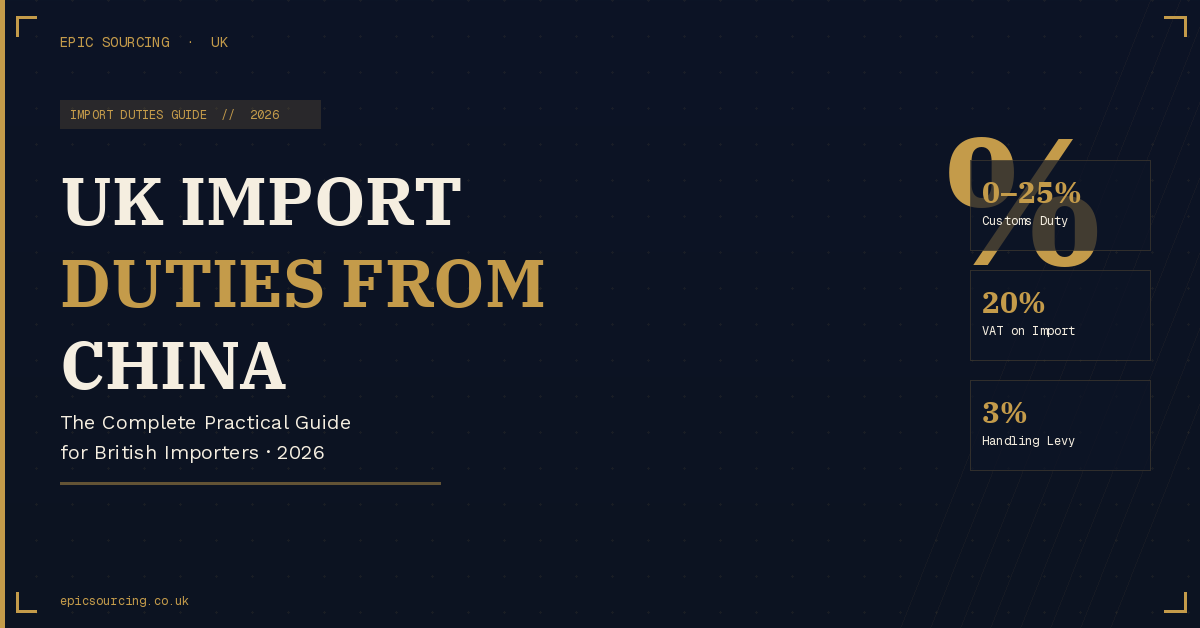
Typical rates by category: clothing and apparel — 12%; footwear — 3.7–17%; consumer electronics — 0–3.7%; furniture and homewares — 3.7–6.5%; sports equipment — 2.7–4.7%; cosmetics and toiletries — 2–6.5%. On top of customs duty, import VAT at 20% applies on the customs value (product + freight + insurance + duty). VAT-registered businesses can reclaim this.
For a full walkthrough with worked examples covering every cost component, see our Complete Guide to Importing from China to the UK. It covers duty calculations, EORI registration, Incoterms, and everything in between.
Cautiously optimistic — but not soon. The July 2026 JETCO meeting produced a commitment to a Trade Services Agreement feasibility study. That is a very long way from an FTA that would reduce tariffs on goods. For context: the UK-Australia FTA took over two years to negotiate once both governments publicly committed. A UK-China FTA would be orders of magnitude more complex — involving intellectual property protections, market access conditionality, national security carve-outs, and political considerations that no feasibility study resolves overnight.
The pragmatic guidance: build your cost structures to work at current duty rates. If a future FTA eventually reduces your duty burden, that is a welcome bonus — not a business plan. Brands that depend on a trade deal that may be five or ten years away are building on uncertain foundations.
Sourcing Hack #3:
For certain product categories, sourcing from Vietnam instead of — or alongside — China can dramatically reduce your UK import duty. Under the UK-Vietnam Free Trade Agreement (UKVFTA), many goods from Vietnam attract 0% duty versus 12% for clothing or 4.7% for sports goods from China. This duty saving alone can make Vietnamese factories more cost-competitive even if their FOB prices are slightly higher. We've published a detailed comparison guide on Vietnam vs China for UK clothing brands in 2026 — well worth a read if you're in fashion, apparel, or activewear.
The improved JETCO diplomatic climate is an opportunity, not a reason for complacency. Here is the practical action list for UK businesses sourcing from China in 2026:
Verify your duty rates. Check your Commodity Codes on the UK Trade Tariff. Look specifically for any anti-dumping measures on your product categories. If your freight forwarder has not flagged these, ask directly.
Build supplier relationships with confidence. The diplomatic environment is stable. If you have been holding off on investing in supplier development — factory audits, sampling, relationship-building — now is a good time to move forward. Our guide to finding reliable manufacturers in China is a solid starting point.
Consider supply chain diversification. Not abandoning China — but building parallel relationships in Vietnam or India. This reduces single-country dependency without sacrificing cost competitiveness. Our Private Label and Secret Label sourcing packages are designed precisely for this kind of multi-country strategy.
Understand your total landed cost. Duty is only one component. Freight, insurance, 3PL, quality control, and financing costs all add up. Working with an experienced sourcing agent gives you full visibility before you commit to an order.
No. The JETCO meeting focused on UK services exports to China and diplomatic relationship-building. It did not change UK import duty rates on goods from China. Standard UK Global Tariff (MFN) rates continue to apply, and there is no UK-China Free Trade Agreement in place as of July 2026.
JETCO (Joint Economic and Trade Commission) is the principal bilateral trade forum between the UK and Chinese governments. It meets periodically to discuss market access, trade barriers, regulatory cooperation, and economic issues. While JETCO meetings rarely result in immediate tariff changes for goods importers, they set the tone for the UK-China trade relationship and signal whether trade friction is increasing or decreasing — which matters enormously for supply chain planning.
Rates vary by product under the UK Global Tariff. Common examples: clothing 12%, consumer electronics 0–3.7%, furniture 3.7–6.5%, sports equipment 2.7–4.7%, cosmetics 2–6.5%. Import VAT at 20% applies on top of the customs value. Some categories carry additional anti-dumping duties. Always verify using the UK Trade Tariff with your specific Commodity Code.
No. As of July 2026, there is no UK-China FTA. All goods imported from China into the UK are subject to standard MFN tariff rates under the UK Global Tariff. A Trade Services Agreement feasibility study was announced at the July 2026 JETCO meeting, but this relates to services trade and is far from a goods FTA.
Practical options include negotiating lower FOB prices to offset the duty burden; using a duty deferment account for cash flow management; considering Vietnam for categories where UKVFTA preferential rates apply; working with an experienced sourcing agent for factory-direct pricing; and ensuring correct Commodity Code classification to avoid overpaying on misclassified products.
In the near term, less so than in previous years. The improved UK-China diplomatic climate post-JETCO reduces the risk of sudden punitive tariffs. However, the broader geopolitical environment — particularly US-China tensions — continues to create complexity, and HMRC has become increasingly vigilant about Rules of Origin compliance. Building supply chain resilience remains important regardless of the diplomatic temperature.
Navigating UK import duties and building a cost-efficient China supply chain is exactly what we do at Epic Sourcing. Whether you are sourcing from China, Vietnam, or both — we help UK SMEs find the right factories, manage their costs, and import confidently.
📩 Get in touch: hello@epicsourcing.co.uk | 07551 136406 | Book a free Zoom strategy call
TK Wang, Founder & Director @ Epic Sourcing