It’s never been a better time to start selling products online and we’re here to share our knowledge. Today’s topic is how to find the best suppliers on Alibaba.


Greetings eCommerce up-and-comers!
In this section of the blog we talk about how to source products like a pro. It's never been a better time to start selling products online and we're here to share our knowledge. Today's topic is how to find the best suppliers on Alibaba.
As a sourcing agent for small businesses, one of the biggest queries I get is about how to find the right supplier in China. The rise of B2B sites like Alibaba and Global Sources has made it easier than ever to connect with suppliers and manufacturers, but having a nearly infinite number of options can make the process a daunting one.
Supplier prospecting is one of the most important steps in the sourcing process, but one that many businesses rush through as they excitedly move towards getting their product to market. Getting this step right will save you A LOT of time, money, and hassle further down the track.
So, in this post we'll show you how to find the best suppliers on Alibaba for your online business.

There are 3 main options when it comes to initiating your search for a Chinese supplier:
Unless you've been living under a rock, you've probably heard of Alibaba. For the novice, Alibaba is an excellent place to start. As it's the largest and most well-established B2B marketplace, it's a straightforward place to begin your search. Many people argue that there is a lot of 'noise' to wade through on Alibaba, and Global Sources is a better option in that respect. We would agree, but for the beginner, Alibaba is simple to use, with more products on offer, and quite often lower MOQs.
As they say, nothing beats being there. Visiting a trade fair like The Canton Fair in Guangzhou can be an eye-opening experience for an eCommerce business owner. Not only does it allow you to connect with suppliers face to face, but it's a fantastic way to find new products and see what's coming through the pipeline in your particular niche.
The 3rd option is to essentially outsource the prospecting phase. A sourcing agent worth their salt will be able to connect you with top suppliers and essentially guide you through the process so you don't have to do the research and due diligence. Read more about whether a sourcing agent is right for you here.
Come prepared. As we'll see later in the process, it pays to be prepared with as much information as possible before you start reaching out to suppliers or manufacturers.
Understand the product you want to source. Know the dimensions, the weight, its functionality, and what materials it's made of. Knowing this will show potential suppliers that a) you are serious, and b) you know what you want. Communication is key, so you need to be very clear about what you need.
Having some key numbers on hand will help you determine whether or not a supplier is right for you. Have an idea of the following:
These numbers will almost certainly change as you move through the process, but it helps establish solid ballpark figures to work with.
Are you creating a bespoke, original product from scratch, or are you looking to source a product that already exists?
Manufacturing a product from scratch is going to be a more expensive and time-consuming process. If you're just starting out, you might be able to dip your toes with a white label product that fits within your product line. This is also a great way to fill out your product line over time. Many eCommerce entrepreneurs have a flagship product designed from scratch and then add white label products to sell as supplementary offerings.
Many people think that if you want to start selling a branded product, you need to invent it. Not so! There are millions of products you can buy from suppliers in China, rebrand with your own logo, and sell online to your target market. Your margin won't be as big if you're white labelling, but neither will the bill to source it.
China is big. From a sourcing perspective, it makes more sense to look at it as multiple, specialised regions rather than one homogenous zone. Finding a supplier or manufacturer that specialises in the products you are looking to import is a great start. They will have plenty of experience dealing with similar businesses, understand industry quality standards and pricing, and be quick to understand any changes you might require.
For your reference, here is a map of the main manufacturing areas, or industrial clusters in China.
Armed with the above info, it's time to start wading through your options on Alibaba. Naturally, your search will start by entering the name of the product you're looking for.
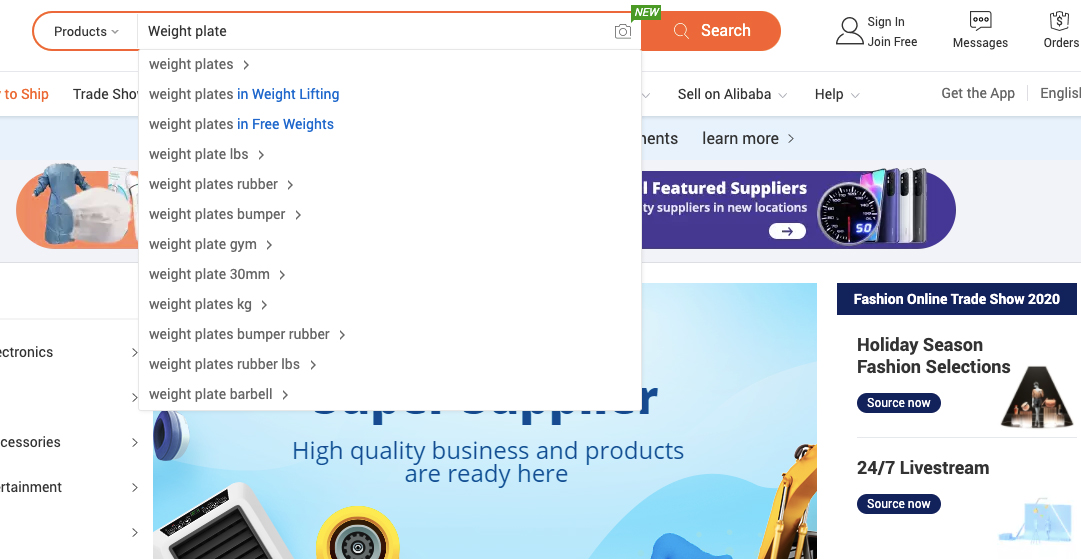
Be specific with the keywords you enter and narrow down the options. Once you've done your initial search, there are some useful filters to further narrow down your options.
Trade Assurance is a way to protect yourself should the supplier fail to deliver on their promises. If a supplier doesn't ship your products, can't deliver on time, or the quality is below what was agreed, you can make a claim.
A Verified Supplier has been verified by a 3rd party not affiliated with Alibaba. This covers the company profile, management system, production capabilities, and process controls.
It can be useful to narrow down your search to suppliers operating in the region that specialises in the products you are looking to source.
There is also an option to filter by ISO certification. ISO9001 is an international standard that outlines adherence to a quality management system (QMS).
It's worth noting that just because a supplier hasn't had 3rd party verification, doesn't mean it's fraudulent or bad. But, if you're tackling the sourcing process alone, you want to take steps to minimise the risk.
B2B marketplaces are rife with middlemen. How can you skip the Trading Company or middle person?
Some red flags to watch out for: no pics of the factory floor; a wide array of unrelated products.
Having taken the steps above, you're ready to start building a list of prospective suppliers. Create a spreadsheet and collect the following information before contacting suppliers:
Ideally, you want to create a list of between 10–20 suppliers. This will give you a good overview of which suppliers are outliers in terms of price or other contract terms.
Once you've compiled a list of potential suitors, it's time to make contact. Here is an example of what your initial email might look like (feel free to use this):
Tip: Remember that you are dealing with people that probably don't speak fluent English — keep it simple.
Hello [Vendor name],
My name is [name] and I'm a buyer for [company]. We are based in the UK and want to stock some of the products that you offer. I would like pricing and availability for the items listed below. I would also like MOQs and real photos of the products if possible.
[Product name]
Per unit cost for: [100] units / [500] units / [1,000] units
Additional questions:
Can you arrange packaging?
Can you arrange for our logo to be printed on the product?
Can we get a sample sent to our office in the UK?
Kind regards, [Name]
Tip: Given that you may experience a large influx of emails, many people create a new email address specifically for contacting prospective suppliers.
With the information gathered from your mail-out, you'll be able to further populate your supplier prospecting spreadsheet. Good suppliers will communicate clearly and professionally, in a timely manner, and answer all of your questions.
Once you've populated your spreadsheet you should be able to easily whittle down the options to your top 2–3 suppliers. From there, it's time to order a sample. The ball is well and truly rolling!
So, there you have it — our guide on how to find the best suppliers on Alibaba for your online business.
Everyone wants the best suppliers, but finding them can be tricky. It's tempting to fly through the process, but if you do it right you'll save yourself a lot of time, and potentially some large headaches further along in your sourcing journey.
If you're interested in hearing about how Epic Sourcing UK can help you source products from China, drop us a line here!
Better sourcing everybody.